
How Family Dental Services Can Support Preventive Care
Family dental services can support preventive care by assessing each person’s risk of tooth decay and gum disease, monitoring changes over time and recommending care that matches their needs. Prevention involves more than a routine clean: it combines professional assessment with practical habits at home and informed decisions about treatment.
For families in Geelong, a useful preventive plan should explain what needs attention, what can be monitored and when another review is appropriate. It should not assume that every family member needs the same appointment schedule or treatment.
How family dental services support prevention
Brushing and cleaning between teeth are important, but they cannot show everything happening in the mouth. A dental examination can identify concerns such as early decay, gum inflammation or changes around existing fillings that may not be obvious at home.
Professional care also provides an opportunity to review whether your current routine suits your circumstances. Medicines, health conditions, dental appliances and difficulty brushing can all affect that discussion.
Understanding why a dental examination comes before treatment can help you distinguish between assessing a concern and deciding whether a procedure is necessary.
A risk assessment, rather than a standard package
A preventive assessment considers your dental history alongside your current oral health. Your dentist may ask about previous decay, bleeding gums, smoking, eating patterns and medicines that cause a dry mouth. Saliva helps protect teeth, so reduced saliva can change the advice you receive.
The preventive value of family dental services comes from using this information to tailor care, rather than offering everyone the same package.
| Finding or circumstance | Possible preventive response |
|---|---|
| Recent or repeated tooth decay | Review contributing factors and discuss suitable fluoride options |
| Bleeding gums or plaque build-up | Assess gum health and review cleaning techniques |
| Dry mouth | Consider possible causes and discuss ways to manage its effects |
| Difficulty cleaning around braces or restorations | Adapt cleaning tools and techniques |
| Stable oral health with few risk factors | Agree on a review interval based on the individual assessment |
These are examples, not automatic treatment recommendations. A finding needs to be considered in context before a care plan is agreed.
What a preventive appointment may involve
Checking teeth, gums and the tissues inside the mouth
Your dentist may examine your teeth, existing dental work, gums and the soft tissues inside your mouth. Depending on the findings, they may check for bleeding or measure the spaces between teeth and gums to assess gum health.
You should also have an opportunity to mention sensitivity, discomfort, a change in your bite or an area that is difficult to clean. Something that seems minor to you may help explain a change found during the examination.
Not every appointment requires the same tests. Your dentist should explain what an assessment is intended to investigate and how the findings could affect your care.
Cleaning and targeted preventive treatments
Within family dental services, professional cleaning and preventive treatments should respond to identified needs. Cleaning can remove calculus, which is hardened plaque that brushing alone cannot remove. It does not replace daily cleaning or guarantee that gum problems will not return.
Fluoride treatments may be considered for people with an increased risk of decay. Fluoride helps strengthen tooth enamel, the hard outer surface of a tooth. As Healthdirect explains in its information about tooth decay, early decay may be managed differently from a cavity that has already formed.
A dentist may also discuss fissure sealants. These are protective coatings placed in selected grooves of back teeth, where plaque and food can collect. They may help reduce decay in those grooves, but they do not protect every tooth surface and need monitoring.
All procedures have potential benefits and risks. Cleaning can cause temporary sensitivity or gum tenderness, while sealants may wear or come away. Suitability for fluoride products depends on factors such as age, decay risk and relevant allergies. Your dentist should explain the options, limitations and alternatives before proceeding.
Review intervals and dental X-rays should be personalised
A check-up schedule that reflects your needs
A six-monthly check-up is not a rule for everyone. Your dentist may recommend a shorter or longer interval based on current findings, previous disease, home care and other risk factors.
A person with active gum disease may need closer review than someone whose oral health has remained stable. A new medicine causing dry mouth may also justify reassessing a previously suitable schedule.
When family dental services include ongoing review, the purpose is to check whether the plan is working and adjust it when circumstances change. Ask what the next appointment is intended to assess and why that timing has been suggested.
X-rays when they can answer a clinical question
Dental X-rays can reveal information that is not visible during an examination, such as decay between teeth. They should be recommended according to clinical need, not automatically because another appointment has arrived.
X-rays use ionising radiation, so the expected diagnostic benefit needs to justify the exposure. Your dentist considers factors such as symptoms, examination findings, previous images and your dental history.
Monitoring can also be an appropriate choice for some findings. If treatment is not currently recommended, ask what would indicate a change and when the area should be reviewed.
Turning examination findings into a practical home-care plan
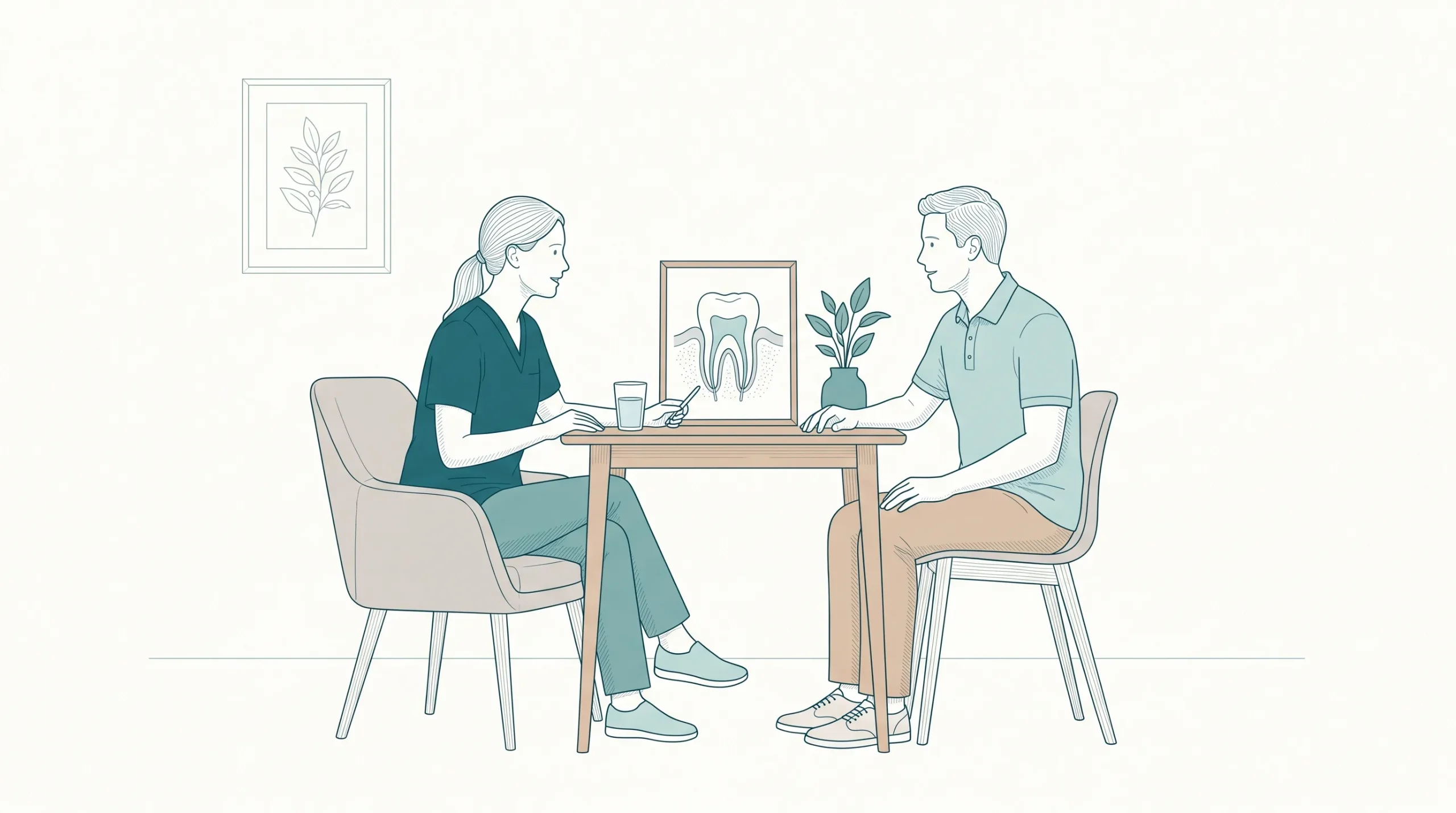
Advice is more useful when it addresses a specific difficulty. If plaque collects around a crowded tooth, your dentist can demonstrate how to reach that area. If arthritis makes brushing difficult, a different handle or an electric toothbrush may be worth discussing.
For children, advice should account for their age, ability to brush and the support they need from an adult. Toothpaste selection and the amount used also need to be age-appropriate.
Family dental services can help connect these everyday decisions with the findings from an examination. However, the plan needs to be manageable for your household, rather than a long list of changes that are difficult to maintain.
Useful questions include:
- What should we prioritise? Ask which change is most relevant to the findings today.
- Can you demonstrate the technique? Seeing how to clean a difficult area can make advice easier to follow.
- How will we know whether it is helping? Agree on what will be checked at the next review.
For broader guidance on daily routines, see how to care for teeth between dental visits. The professional assessment and your home routine should support each other.
Costs, access and informed decisions
A preventive care plan should be clear about fees as well as clinical recommendations. Ask what the proposed appointment includes, whether X-rays or cleaning involve separate charges and what any further treatment would cost.
It is reasonable to ask whether something needs treatment now, can be monitored or has an alternative. If cost affects your decisions, discuss this before agreeing to care so the dentist can explain appropriate priorities and the implications of delaying treatment.
When arranging family dental services, parents can also ask about eligibility for the Child Dental Benefits Schedule. This Australian Government programme helps cover certain dental services for eligible children, subject to benefit limits and programme rules.
Gentle Dental Geelong offers bulk-billed children’s dental care through this scheme. Confirm your child’s eligibility, remaining benefits and which proposed services can be bulk billed before the appointment. Not every dental service is covered.
Being able to take an active role in dental care decisions includes asking for explanations and taking time to understand the options.
Symptoms that should not wait for a routine review
A planned check-up schedule does not mean you should wait if a new concern develops. Contact a dentist for toothache, persistent bleeding gums, a loose adult tooth, a broken tooth or swelling. A mouth ulcer or other change that has not healed after about two weeks also needs assessment.
These symptoms can have different causes, so an examination is needed rather than assuming they indicate a particular condition.
Significant facial swelling, especially with fever, needs urgent assessment. If swelling affects breathing or swallowing, call 000 or attend an emergency department. This is different from arranging an ordinary preventive appointment.
Frequently asked questions
Can preventive care guarantee that my family will not need fillings? No. Family dental services may help reduce risk and identify problems earlier, but decay can still develop. The outcome depends on factors including oral health, saliva, diet and daily cleaning. A cavity may require a filling or another treatment despite preventive care.
Do I need a check-up if nothing hurts? An absence of pain does not confirm that teeth and gums are healthy. Some dental problems have few noticeable symptoms initially. Your dentist can recommend an appropriate review interval based on your history and examination, rather than relying on discomfort alone.
Is a professional clean enough to manage bleeding gums? Not necessarily. Bleeding needs assessment to understand the cause and extent of any gum disease. Professional cleaning may form part of care, but daily plaque removal and, in some cases, further treatment are also needed.
What if it has been several years since my last visit? Tell the dental team about the gap and any concerns you have. An examination can establish your current oral health and help prioritise appropriate care. A long gap does not automatically mean you need extensive treatment.
Discuss preventive care in Geelong
Gentle Dental Geelong provides general family dentistry in Geelong. To discuss your household’s preventive care needs, you can arrange an appointment with Gentle Dental Geelong. An individual assessment can clarify your current oral health, suitable review timing and the potential benefits, risks and alternatives of any recommended treatment.